
Consignor payout systems are the backbone of a well-run consignment business. When people trust a store with their merchandise, they expect accurate sales tracking, fair consignor commissions, clear payout schedules, and records that show exactly what sold and what they earned.
A reliable consignor payment process protects both the store and the consignor. It connects item intake, pricing, sales activity, returns, markdowns, fees, taxes, payout reports, and consignor account balance updates into one organized workflow.
For store owners, resale shops, boutique retailers, thrift stores, inventory managers, and small business operators, consignor payout systems reduce manual work and help prevent uncomfortable payout disputes. They also make it easier to answer common questions like “Did my item sell?”, “Why is my payout lower than expected?”, or “When will I be paid?”
A strong consignment payout system is not just about sending money. It is about keeping item-level records, applying store policies consistently, documenting every adjustment, and giving consignors transparent information they can trust.
What Are Consignor Payout Systems?
Consignor payout systems are tools and workflows that help consignment stores calculate, track, approve, and issue payments to consignors after their items sell. In a consignment model, the store sells goods on behalf of the consignor, then splits the sale amount according to an agreed commission structure.
A consignor payout system usually tracks the original item price, final sale price, discount amount, commission rate, store share, consignor share, fees, returns, taxes, and payment status. The system also updates the consignor account balance as items sell, payouts are issued, or adjustments are made.
For example, if an item sells for 100 and the consignment sales split is 60/40 in favor of the consignor, the consignor earns 60 before any applicable deductions. If the item was discounted, returned, or subject to a fee, the system should show how that affected the final payout.
This is where consignment payment tracking becomes essential. Without reliable item-level tracking, stores may struggle to connect a sale to the correct consignor. That can lead to underpayments, overpayments, duplicated payouts, missing records, or disputes that take time to resolve.
A good consignment store payout system helps answer three important questions:
- Which consignor owns the item?
- What payout rules apply to that item?
- Has the consignor already been paid?
How the Consignor Payment Process Works
The consignor payment process usually begins before an item reaches the sales floor. Payout accuracy depends on the agreement, item record, pricing rules, commission structure, and store policies entered at intake. Once the item sells, the system calculates the consignor’s share, updates the account balance, and includes the sale in a payout report.
Most stores do not pay consignors immediately after every sale. Instead, they use payout schedules, such as weekly, biweekly, monthly, or after a return window closes. This gives the store time to account for returns, voids, payment issues, and manual adjustments.
A modern workflow often includes intake, tagging, sale tracking, commission calculation, payout review, payment issuance, and reporting. POS-connected workflows are especially useful because they tie sales, inventory, and consignor records together.
For more detail on how POS tools connect sales to payout math, see this guide on how POS systems calculate consignor payouts.
| Step | What Happens | Why It Matters |
| 1. Consignor setup | Store creates a consignor profile with contact details, agreement terms, payout method, and commission rules. | Ensures the system knows who owns each item and how payouts should be calculated. |
| 2. Item intake | Staff enters item details, price, category, condition, markdown rules, and consignor ownership. | Prevents mislabeling and supports item-level sales tracking. |
| 3. Sale tracking | The item is scanned or selected at checkout and linked to the sale transaction. | Connects revenue to the correct consignor. |
| 4. Commission calculation | The system applies the agreed split, fees, discounts, and rules. | Reduces manual math errors. |
| 5. Payout approval | Staff reviews payout reports, account balances, returns, and adjustments. | Prevents paying the wrong amount or paying too early. |
| 6. Payment issuance | The store pays by cash, check, digital payment, store credit, or another approved method. | Completes the consignor settlement process. |
| 7. Reporting | The consignor receives a statement showing sold items, amounts, fees, and payment status. | Builds trust and reduces follow-up questions. |
Item Intake and Agreement Setup
Item intake is where payout accuracy begins. Before a store accepts merchandise, it should define the consignor agreement, commission rate, payout terms, markdown rules, return policy, item expiration policy, and accepted payment methods.
Each item should be connected to the correct consignor from the beginning. The item record should include details such as description, category, brand, size, condition, price, intake date, SKU or barcode, and any special terms. This helps prevent confusion later when the item sells or expires.
Consignor agreements should explain how payouts are calculated. For example, the agreement should clarify whether consignor commissions are based on the original price or the final selling price after discounts. It should also explain whether fees, payment processing costs, repairs, cleaning, authentication, or markdowns affect the consignor share.
Sale Tracking and Commission Calculation
Once an item sells, the sale must connect to the correct item record and consignor. This is the moment when the consignment payout system calculates the consignor share and updates the consignor account balance.
Accurate sale tracking matters because many consignment stores carry one-of-a-kind inventory. Two items may look similar but belong to different consignors, have different prices, or follow different commission rules. Barcode labels, unique SKUs, and item-level tracking help avoid mistakes at checkout.
The commission calculation should follow the store’s policy exactly. If an item sells with a discount, the system should know whether the consignor split applies to the discounted sale price. If a fee applies, the system should show whether it is deducted before or after the split.
A good system creates a clear trail from sale to payout. Staff should be able to see the item, sale date, sale amount, discount, commission rate, store share, consignor share, and payment status.
Payout Approval and Payment Issuance
Before issuing payments, stores should review payout reports and account balances. This review helps catch returns, duplicate transactions, mispriced items, manual adjustments, voids, and items still within a hold period.
Some stores approve payouts in batches. A batch may include all eligible consignors for a payout cycle, such as all balances due after the return period has passed. Staff can review each consignor settlement, confirm payment method, and mark payouts as issued.
Payment methods vary by store. Some offer cash or checks, while others use digital payments or store credit. Store credit payouts can encourage repeat purchases, but the policy should clearly explain whether store credit is optional, required, or offered at a higher rate.
Common Consignment Payout Models

Consignment payouts can be structured in several ways. The right model depends on the store’s inventory type, margins, customer base, average item value, operational costs, and relationship with consignors.
The most common model is a fixed percentage split. For example, the consignor may receive 40%, 50%, or 60% of the sale price, while the store keeps the rest. This is simple to explain and easy to apply across many categories.
Other stores use tiered commissions. Higher-value items may earn the consignor a larger percentage because they bring more revenue and may require stronger consignor relationships. Lower-value items may have a smaller consignor share because handling, tagging, merchandising, and selling costs can consume more of the margin.
Category-based payouts are also common. Apparel, furniture, jewelry, collectibles, luxury goods, electronics, and home décor may each have different handling costs and sales cycles. A consignment store payout system should support these differences without forcing staff to calculate everything manually.
Some stores also offer store credit payouts, cash payouts, check payouts, or digital payouts. Each method should be documented, and each issued payment should be recorded in the consignor’s history.
Percentage-Based Commission Splits
Percentage-based commission splits are the most familiar consignment payout model. The store and consignor agree to divide the final sale amount by a fixed percentage. A 50/50 split means each party receives half. A 60/40 split in favor of the consignor means the consignor receives 60% and the store keeps 40%.
The key detail is what amount the percentage applies to. Stores should define whether the split is based on the original price, discounted sale price, pre-tax amount, post-tax amount, or amount after fees. Most stores apply the split to the item’s selling price before sales tax, but policies vary.
Discounts and markdowns need special attention. If an item originally listed for 100 sells for 70 after a markdown, the payout system should calculate the consignor share based on the policy. If the split applies to the actual sale price, a 50% consignor share would be 35.
Tiered or Category-Based Payouts
Tiered or category-based payout models give stores more flexibility. A tiered model may pay a higher consignor percentage when an item sells above a certain value. For example, lower-priced items may use a 40% consignor share, while higher-priced items may use 60%.
Category-based payouts work well when different inventory types require different effort. Furniture may need floor space, delivery coordination, or repair. Luxury goods may require authentication. Apparel may require steaming, tagging, sizing, and frequent markdowns. Electronics may need testing.
These differences affect profitability. A single fixed split may not reflect the real cost of selling each type of item. A category-based consignment payout system helps stores protect margins while still offering fair consignor commissions.
However, these models must be easy to document. Consignors should understand why one item earns a different rate than another. Staff should also know where to find the rule when answering questions.
Key Features of a Consignment Store Payout System

A strong consignment store payout system should do more than calculate percentages. It should create a reliable workflow for consignor management, inventory tracking, sales tracking, payout approval, payment history, and reporting.
The most important feature is consignor profiles. Each profile should store contact details, payout preferences, agreement terms, tax-related information when needed, communication history, and account balance. This gives staff a single place to review the consignor relationship.
Item-level tracking is equally important. Every item should have its own record, price, status, category, consignor, sale history, and payout status. This is especially useful for resale shops where inventory is unique and constantly changing. For related inventory workflow guidance, see this resource on tracking consignor inventory and sales.
Useful payout system features include:
- Consignor profiles and agreements
- Item-level ownership tracking
- Automatic commission calculation
- Flexible commission rules
- Payout schedules
- Consignor account balance tracking
- Return and refund handling
- Fee and adjustment tracking
- Payout reports and statements
- Payment history
- Audit trails
- Staff permissions
- Exportable reports
- Tax reporting support
Audit trails deserve special attention. If a payout amount changes, the system should show what changed, who changed it, and why. This protects the business and helps resolve questions quickly.
How Consignment POS Payouts Improve Accuracy
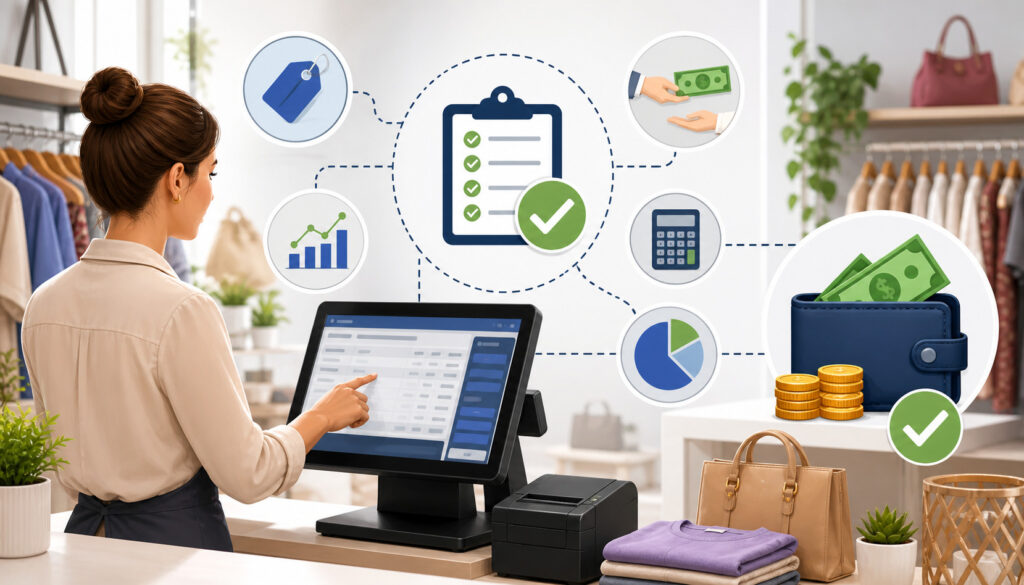
Consignment POS payouts improve accuracy by connecting the checkout process directly to inventory, consignor records, commission rules, receipts, refunds, and payout reports. Instead of recording sales in one system and calculating payouts in another, the POS updates the consignor balance when the sale happens.
Manual spreadsheets can work for a very small operation, but they become risky as inventory grows. A single wrong formula, missing row, duplicate item, or mislabeled consignor can create payout errors. These mistakes are frustrating for staff and damaging to consignor trust.
A POS-connected payout workflow reduces those risks. When staff scan an item at checkout, the system identifies the item record, confirms the consignor, applies the sale price, calculates the commission, and updates the payable balance. If the customer returns the item, the system can reverse or adjust the payable amount.
Consignment POS payouts also improve consistency. The same rules are applied every time, regardless of which staff member handles the transaction. This matters in busy stores where multiple employees receive inventory, ring up sales, process returns, and answer consignor questions.
For more on how POS workflows combine intake, barcoding, checkout, and payouts, this article on how a consignment store point of sale works is a useful reference.
Real-Time Consignor Account Balances
Real-time consignor account balances help stores answer questions quickly. Instead of searching through receipts or spreadsheets, staff can open the consignor profile and see current unpaid earnings, paid amounts, pending items, sold items, and adjustments.
This is especially helpful when consignors call or visit the store. They may want to know which items sold, what their balance is, or when the next payout will happen. A current balance reduces confusion and shows that the store is organized.
Real-time balances also help owners manage cash flow. If a payout cycle is approaching, the store can review total payable balances and plan accordingly. This prevents last-minute surprises and makes settlement smoother.
Clear Payout Reports
Payout reports are one of the most important trust-building tools in consignment. A good payout report should show more than a total amount. It should explain how the total was calculated.
A useful payout report typically includes:
- Consignor name or account number
- Sold item descriptions
- Sale dates
- Sale prices
- Discounts or markdowns
- Commission rates
- Store share
- Consignor share
- Fees or adjustments
- Returns or reversals
- Payment method
- Payment date
- Remaining account balance
Clear payout reports reduce follow-up questions because consignors can see the math. They also help staff review payout batches before payments are issued. For a deeper look at report automation, see this guide on automating payout reports for consignors.
Common Payout Mistakes to Avoid
Even experienced resale shops can run into payout problems if their process is unclear or inconsistent. Most mistakes happen when stores rely too heavily on manual tracking, incomplete intake records, verbal agreements, or rushed payout approvals.
One common mistake is unclear commission terms. If the store does not explain how discounts, markdowns, fees, taxes, or returns affect payouts, consignors may feel surprised when they receive less than expected.
Another mistake is paying before the return window closes. If the customer returns an item after the consignor has already been paid, the store must either recover the funds, deduct the amount from a future payout, or absorb the loss. Each option can create friction.
Mislabeling items is another serious issue. If an item is assigned to the wrong consignor, the wrong person may be credited. Barcode labels and careful intake procedures reduce this risk.
Stores should also avoid skipping payout approvals. Even with automation, someone should review exception cases, negative balances, unusually large payouts, returned items, and manual adjustments before payment.
Other payout mistakes include:
- Using spreadsheets without regular reconciliation
- Failing to document special commission rates
- Not tracking store credit separately
- Forgetting to deduct approved fees
- Not updating consignors about payout schedules
- Mixing unpaid, pending, and paid balances
- Deleting records instead of adjusting them
- Failing to keep payment history
Best Practices for Managing Consignor Payouts
The best consignor payout systems combine clear policies, reliable technology, consistent routines, and transparent communication. The goal is to make payouts predictable for consignors and manageable for staff.
Start with written agreements. Every consignor should understand commission rates, payout timing, markdown policies, fees, return rules, expired inventory handling, and payment methods before items are accepted. This agreement should be easy for staff to access later.
Use item-level tracking from intake to settlement. Each item should have a unique identifier, barcode, or SKU that connects it to the consignor. This allows the store to track whether the item is received, priced, tagged, available, sold, returned, expired, donated, or paid out.
Create a consistent payout schedule. Whether payouts happen weekly, monthly, or on another cycle, consistency helps consignors know what to expect. If payouts are only available after a minimum balance or return window, state that clearly.
Use approval workflows. Before issuing payments, review payout reports for returns, adjustments, negative balances, fees, special rates, and unusual activity. This small step can prevent major errors.
Reconcile regularly. Compare POS sales, payout reports, payment records, and bank activity. Reconciliation helps catch missed payments, duplicate payouts, and recording errors.
Helpful habits include:
- Use standardized intake forms.
- Print barcode labels for accepted items.
- Keep commission rules inside the system.
- Review payout batches before issuing payments.
- Provide itemized payout reports.
- Document every adjustment.
- Keep payment history by consignor.
- Train staff on payout policies.
- Review reports for aging inventory and unpaid balances.
How to Communicate Payout Policies to Consignors
Good communication prevents many payout disputes before they happen. Consignors should understand how the store calculates commissions, when payouts are available, what payment methods are offered, and how returns or markdowns affect their earnings.
Start during onboarding. Before accepting items, explain the commission rate, expected selling period, pricing process, markdown schedule, fees, and payout cycle. This helps set expectations early.
Use direct, specific wording. Instead of saying “You get paid after your item sells,” explain when the payout becomes eligible. For example, the policy might say payouts are processed after the return period closes and during the next scheduled payout cycle.
Payout reports should also be easy to understand. A consignor should be able to see what sold, when it sold, what it sold for, what commission rate applied, what the store kept, what the consignor earned, and whether the amount has been paid.
Stores should explain key topics such as:
- Commission rates
- Payout timing
- Payment methods
- Minimum payout balances
- Return windows
- Markdown schedules
- Fees and deductions
- Expired or unsold inventory
- Store credit options
- Reporting access
It is also helpful to have a short payout policy available at intake, on receipts, or through a consignor portal. Staff should use consistent wording when answering questions.
FAQs
What is a consignor payout system?
A consignor payout system is a process or software tool that helps consignment stores track sold items, calculate consignor commissions, update account balances, and issue payments. It connects item records, sales transactions, commission rules, returns, adjustments, and payout reports so stores can manage payouts accurately.
How are consignment payouts calculated?
Consignment payouts are usually calculated by applying an agreed commission rate to the eligible sale amount. For example, if an item sells for 80 and the consignor receives 50%, the consignor earns 40 before any applicable deductions. Discounts, fees, markdowns, returns, or store policies may affect the final payout.
When should consignors be paid?
Consignors should be paid according to a consistent payout schedule, such as weekly, biweekly, monthly, or after the return window has closed. A clear schedule helps consignors know when to expect payment and gives stores time to review returns, adjustments, and account balances.
What should a payout report include?
A payout report should include sold items, sale dates, sale prices, discounts, commission rates, store share, consignor share, fees, adjustments, payment method, payment date, and remaining account balance. Itemized reports make payouts easier to verify and reduce disputes.
Can a POS system calculate consignor commissions?
Yes. A consignment POS system can calculate consignor commissions by linking item records, consignor profiles, sales transactions, and commission rules. It can also update account balances, handle returns, generate payout reports, and track payment history.
How do returns affect consignor payouts?
Returns can reduce, reverse, or delay consignor payouts. If an item is returned before payment is issued, the sale is usually removed from the payable balance. If the consignor has already been paid, the store may deduct the amount from a future payout according to its policy.
What is the best way to avoid payout disputes?
The best way to avoid payout disputes is to use written agreements, item-level tracking, barcode labels, automatic commission calculations, consistent payout schedules, documented adjustments, and clear payout reports. Transparent records help both the store and consignor verify payout details.
Should stores offer cash, check, digital payout, or store credit?
Stores can offer cash, check, digital payout, store credit, or a combination of methods depending on their operations. The chosen methods should be clearly explained in the payout policy and recorded in the consignor’s payment history.
Conclusion
Consignor payout systems help consignment stores calculate commissions accurately, track item sales, manage consignor account balances, issue payments, and maintain trust. A reliable system turns a potentially messy process into a clear workflow from intake to final settlement.
The strongest payout processes are built on clear agreements, accurate item records, consistent commission rules, reliable sale tracking, thoughtful payout approval, and transparent reports. When consignors can see what sold, how their share was calculated, and when they will be paid, they are more likely to trust the store and continue bringing quality inventory.
For resale shops, boutique retailers, thrift stores, and small business operators, better payout management is not just an administrative upgrade. It supports stronger relationships, fewer disputes, cleaner records, and smoother daily operations.